I belong to the Music Teacher National Association which is an American professional association of music teachers whose mission is to advance the value of music study and music making in society and to support the professionalism of music teachers. MTNA has a membership that includes 73% independent teachers, 14% college or university instructors, 5% students, and 8% Commercial Studio Instructor, Public or Private Teacher, Other. Membership in MTNA also includes membership in the appropriate state state association and local association. This means I am also a member of the Washington State Music Teacher Association and my home Edmonds Music Teacher Association.
Members of MTNA can apply for a National Certificate of Teaching Music which allows members like me, who may no longer desire to go back to University for a music degree to receive a well-recognized music teaching credential and put the letters, NCTM, after my name in music teaching circles. I really appreciate that MTNA offers this sort credential for those of us who come to music teaching after a long journey.
The certification program is based upon a set of five standards (called projects) defining what a competent music teacher should know and be able to do. Upon fulfillment of the standards, applicants are granted the MTNA Professional Certification credential with the designation, Nationally Certified Teacher of Music (NCTM). In my case, my final NCTM submittal describing my teaching and studio was 66 written pages plus videos.
The first project was to write my teaching philosophy and a short essay on an additional music teaching topic, like developing a healthy technique, musical skills, expressive performance skills, etc. I have written my teaching philosophy many times as it tends to evolve over time, so this project wasn’t too bad for me. I had also thought previously on the topic of technique, so gathering my thoughts to answer that question wasn’t too onerous.
The second project was to analyze four teaching pieces from the four main style periods of Baroque, Classical, Romantic, and Contemporary. There are six questions about each piece and the answers need to be between 150-300 words. You don’t receive the names of the pieces until after you register, so you can’t prepare prior to registering. This was one of the most intensive projects for me and I had my bibliography/resource books strewn throughout my office while I was writing for this project, especially when I needed to discuss historically and stylistically appropriate interpretations of the pieces as well as information about the musical era characteristics and the specific composer.
The third project is to present your teaching and your personal performance. This was the other very intensive project for me. It included videos of me working with a student on a specific piece with written lesson outlines, self-evaluations, student goals, etc. Finding an appropriate adult piano student was difficult for me because adult students are very individual in their choice of music, how they practice, and how they learn. Also, many of my adult students are quite shy of the camera, so it took quite some time for me to find the right student. As for my personal performance, the most difficult part was that the piece had to be chosen from Level 7 or above in The Pianist’s Guide to Standard Teaching and Performance Literature by Jane Magrath. I play a lot of repertoire that isn’t listed in this guide, however, some of the pieces I played previously as part of my Australian Music Education Board levels were listed in the Magrath book, which was helpful. This project also included documenting outcomes of your teaching, so I submitted videos of my students playing at EMTA events, progress reports, and student conference outlines.
The fourth project was to share information about my teaching environment. This project was the most fun for me as I was able to share photos of my studio and include information about my personal teaching resources.
The fifth project was to discuss my studio business ethics and policies. This project was also pretty reasonable for me. I already have my studio policies listed on my website and pay my taxes every year, so coming up with my budget was pretty easy.
The bibliography was the third most intensive hurdle for me as I hadn’t cited sources in quite some time and figuring out how to cite sources accurately with web resources as well as books and magazines was tedious. However, I finally got my 7 pages of resources in order. After a period of review by myself and some helpful EMTA colleagues, Voilà, I was able to upload my NCTM paper for submission.
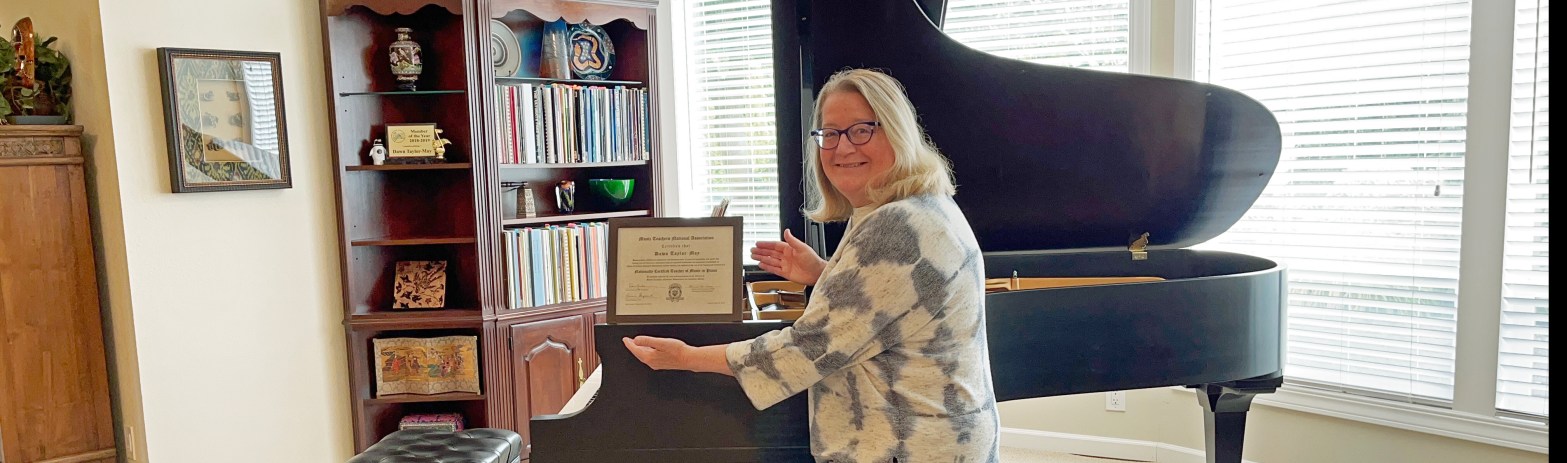
MTNA said it would take between 6-8 weeks to review my certification paper, but it only took a month for me to hear that my application had been approved. Now, I own a fancy certificate and can put NCTM after my name. I shared the email approval notification with my family, former piano and pedagogy teachers, and fellow members of EMTA immediately. After I received the paper certificate in the mail, I had it framed and put on my studio bookshelf. It makes me happy to see it there.
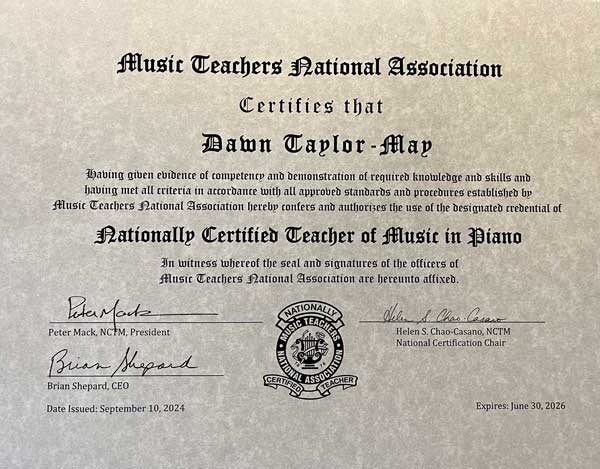
I like the neat signatures of the MTNA officials, it was like they actually took some time to sign their names.
 Piano Lessons for Adults