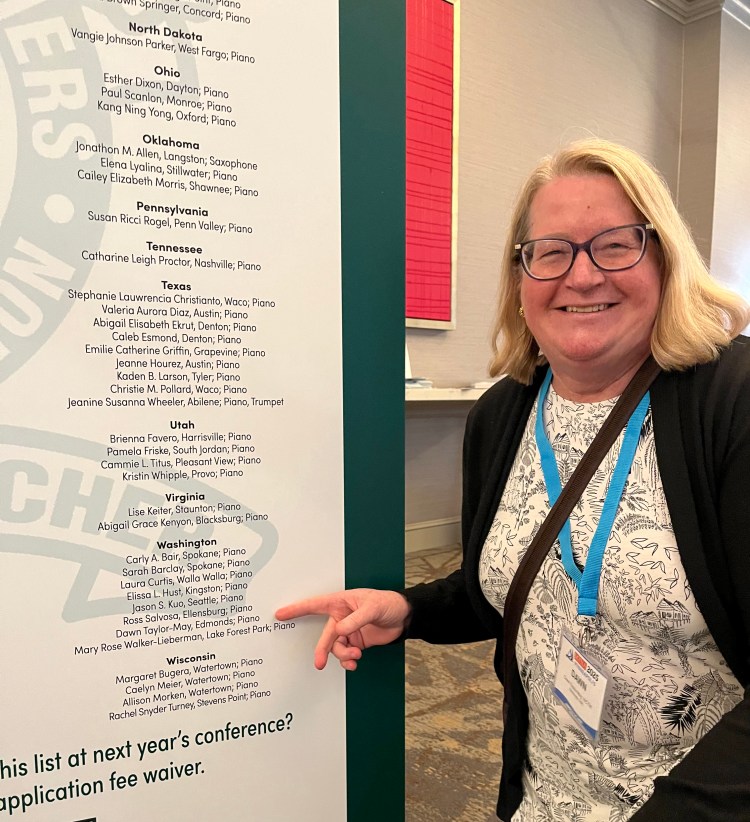
This was my third time going to the National MTNA (Music Teacher National Association) Conference for music teachers. However, it was my first time attending with my NCTM (National Certification for Teaching Music in Piano). Since, I had received my NCTM this year, my name was on the board in the hallway at the conference. Yeah! It was nice to stand up at the NorthWest regional meeting and also at the NCTM reception at the conference to be recognized.
The MTNA Conference is similar to the CES (Consumer Electronics Show) for music teachers. There is “shopping” hall with all the major music publishers, piano manufacturers like Steinway and Yamaha, music teacher technology software, music games, etc. In addition, there are concerts, national competitions for students, and of course many presentations on various aspects of music teaching.
I attended twenty-five presentations at the conference which tends to overwhelm you, so I always try to take notes so I can remember what I saw and heard and hopefully improve my own teaching. My four favorite presentations that I attended from this year’s conference were:
Playing Your Best When It Counts: Strategies to Overcome Performance Anxiety presented by Michelle Wachter, DMA, NCTM
I found this presentation interesting because the presenter talked about her personal journey working through performance anxiety in detail, while recognizing the current science surrounding this topic. She divided the talk into pre-performance strategies, day of performance strategies, and after-performance strategies. I had heard of most of the strategies that she used prior to this talk, but she described in excellent detail how she utilized these strategies. So, it was interesting to hear her exact performance warm-up, her different breathing routines, her detailed visualizations, and her guided meditation that she used on the day of performance. I felt that even though I had tried some of these strategies previously, I didn’t put forth the same level of effort into it that she utilized. Attending this talk helped me understand how to approach some the strategies like visualization in a more concrete way.
Integrating Video Game Music into Piano Repertoire presented by Hannah Viquesney
If I had to live my life over again, taking Hannah Viquesney’s path might be very appealing to me. She is a video game developer and also a music major, which sounds like such a fun life. I attended more than one lecture on video game music, but this was easily the best. I especially liked her great overview of the video game music with many varied examples presented in a tech savvy way. Also, she introduced me to the Materia Collective which helps video game music composers to sell their music and receive the appropriate royalties. It is a very fun site and you can even buy sheet music books from them. It was good to hear that she also used Musescore.org software for transcribing music as I have been using it for years and it is my current favorite for writing music down utilizing a computer. However, I don’t use the latest version, because it is starting to become more commercial. I found it interesting that she also sometimes delves into YouTube for piano arrangement inspiration. As a result of this presentation, I feel that I at least can recognize some of the top video game music creators. It was almost enough to make me wish that I had some younger students that wanted to play this sort of music.
Practice Strategies for Time-Poor Students presented by Samantha Coates
I am very familiar with Samantha Coates as I used a lot of her books when I was taking the Australian Music Education Board (AMEB) exams. She is an extremely dynamic presenter, so it is always great fun to attend her presentations. In this presentation, she talked mostly about three strategies to help super busy piano students find a way to fit in piano practice. Her use of a jelly bean jar to help students understand why they need to practice frequently was genius. However, I need to think a bit about how to utilize a similar strategy with my adult students. Her ideas on interleaved and blocked practice were not new to me, but the way she explained these difficult ideas in a simple and entertaining way was helpful. One new thing I learned was her “Fast-Slow” practice technique. It reminded me of the at-tempo “chaining” technique, but was slightly different, so that was also good to learn. I also totally agreed with her on the “too much” of separate hands practice. I also think playing an entire piece “Right Hand” only is not the most efficient way to practice. It isn’t to say separate hands can’t be useful, but I liked her idea of initially learning 1 line at a time “Hands Together” is a better way to learn a piece than learning the entire piece “Hands Separate” first.
An Insider’s Look into Piano Technique and Movement presented by Mi-Eun Kim, the director of keyboard studies at MIT
I love this presentation because it described leading edge research from MIT on how “elite pianists are able to harness their elastic tissues to be more efficient”. So, in this as yet unpublished research, we were able to get a glimpse into how elite pianists move differently and also how technology can measure with ultrasound how your soft tissues move when playing the piano. I found it absolutely fascinating. Some of my biggest technique “takeaways” from this presentation was that a force plate will measure playing big chords somewhat like internal body jumps. Evidently, your body evidently prepares for that particular movement like it is “jumping”. It was also interesting to realize that elite pianists don’t just move their fingers, they are fully engaged in the music and subsequently utilize organized motions of the many components of the body at the same time to achieve their goal. It was also fascinating to hear that when Mi-Eun Kim got some data about how she was moving in an inefficient way, she fixed the issue by thinking about and analyzing on her own what to do to become more efficient. The Alexander Technique was mentioned during this presentation as some of it’s ideas were realized in the research.
Finally, the concert and advanced master class by the artist, Michelle Cann, was great. I especially liked her second encore after her lengthy and wonderful concert on Tuesday night.
 Piano Lessons for Adults