
I have always been anxious about my piano performances. I can’t seem to shake the idea that “I’m not good enough” or “What will people think of me if I make a mistake”. I’m normally a calm person and I know I perform best when I am calm, but put me in front of an audience expecting a piano performance from me and the anxiety seeps in relentlessly, my thinking becomes disordered, and it is difficult to put myself in the right state of mind for me to play the piano well.
Over the years, I’ve had some successes and failures with my piano performance anxieties. Every once in a while, I play confidently and can tell the audience is “with me”, but those experiences are rare for me. I still love the piano and want to share my music with others. So, I keep trying and have developed some methods of dealing with performance anxiety that do indeed seem to help me, but they are not always guaranteed.
What works best for me
Understanding performance anxiety
There are very good performance anxiety books and courses available. I read and enjoyed “The Inner Game of Tennis by W. Timothy Gallwey” and also took a self-paced Performance Anxiety course from The Bulletproof Musician a number of years back. These resources helped me understand where my anxiety was coming from and helped me try quite a few different techniques with varying degrees of success with dealing with my performance anxiety. I especially liked the idea of the right and left brain functions and how to put yourself in the right brain hemisphere for performance.
Know your piece 200%
In the book “Piano Lessons” by Anna Goldsworthy (which is an ode to her teacher, Mrs. Sivan), Mrs. Sivan says, “It is not enough to understand, …must secure. And one hundred per cent security not enough. Onstage, must be two hundred per cent at least.” I’ve always loved this passage in the book. It was a great way to realize that when you are performing under pressure, it is not enough to simply be able to play your piece well in practice, you must know your piece so well, that it is difficult to play it badly. This idea is also expressed by the quote, “An amateur practices until he can do a thing right, a professional until he can’t do it wrong.” from “Psychology for Musicians” by Percy C. Buck.
Perform your piece under duress prior to an actual performance
My piano teacher always had me perform my exam pieces in local music teacher recitals prior to my AMEB exams. I do think performing your piece under similar conditions to an actual performance is helpful whenever possible. In my “Bulletproof Musician” course, there was also a recommendation to have someone do something extremely distracting when having a “dress rehearsal” in order to practice continuing to play despite distractions. In my own home practice, I like to do something to raise my pulse rate (like jumping jacks), then immediately try to sit down and perform my piece while I am still agitated to see if I can bring myself to focus properly.
Adjust your attitude – Anxiety is good for you
My piano teacher always used to tell me that “nerves can help you play your best”. I love this idea that anxiety can help you to focus well, it doesn’t have to be a detriment to performance. I often try to build this attitude into my psyche whenever possible.
Don’t let stress build up prior to performance
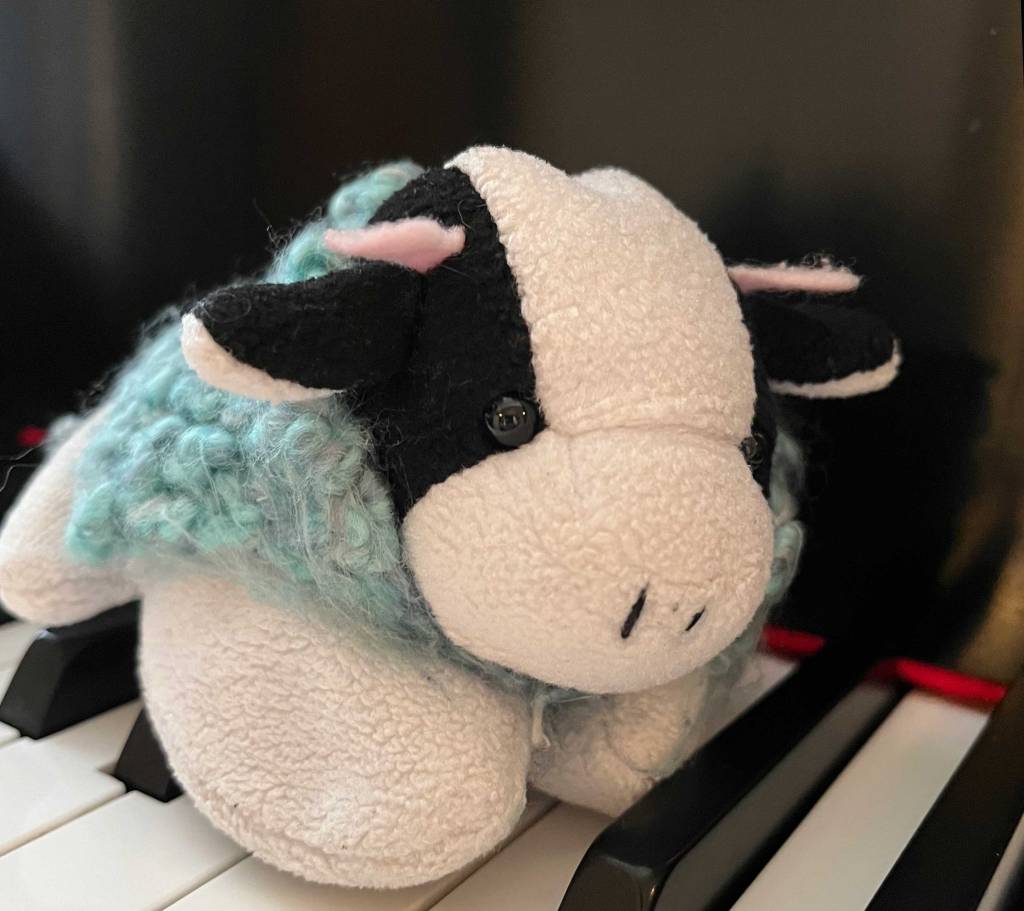
One of the most deadly problems with performance anxiety for me is waiting to perform and having anxiety build up to the point where I will be literally shaking as I perform (usually I have leg shakes). I used to have a piano friend who would jump around prior to a performance to release anxiety, but I tried that once and it didn’t work for me, it just made me more agitated. For me, the most effective method is to keep my mind occupied somehow to prevent the buildup of anxiety. When I have to wait prior to a performance in an audience, I like to use a mindfulness coloring book. I can then do intricate coloring during my wait which distracts me from my own sabotaging thoughts. Another method that helps me is my “comfort cow”. I went into my daughter’s old stuffed animal bin and pulled out a beanbag cow (with a decorative cape made by my daughter). It’s a little silly, but I like it. When I perform at a church service as the pianist, I knead my “comfort cow” as a fidgeting device between songs to release tension while waiting to play.
Breathe and Center
I understand that it can be good to have a routine for when you sit down to perform and that breathing is very important. When I sit down to perform, I always try to breathe and center. I also practice breathing and centering during my home performance practice. I have had mixed results with this technique because when I’m very anxious, it affects my ability to breathe and center. However, I do still like this technique and think it is useful.
Sing the melody in your head while you play during practice, then sing your way into your piece after centering
I love this technique even though it requires a lot of effort. I had one exam piece where I was very good about always singing the piece in my head during my practice. When I went to play this piece for my exam, I couldn’t help but keep singing the piece in my head and I performed the piece very well. Even if I don’t always sing my pieces constantly during my practice, I do always try to sing the beginning of my piece in my head prior to starting my performance as it helps me get the tempo, dynamics, and mood of the piece correct from the beginning.
Let go of mistakes
This is a really valuable lesson. It is pretty easy to make a mistake and then dwell on it and have it snowball into more and more errors. Thinking about your mistakes means that you are not thinking about the music or how to perform, you are just thinking of your own emotional misery. During my performance practice, I always try to “let go” of my mistakes and bring myself back to the music. This idea of letting go is also one of my favorite affirmations.
Affirmations
One of the best ideas I ever came up with to help me with performance anxiety is the use of affirmations. With these affirmations, I try to build up my own confidence in myself and my abilities. I do my best to make the affirmations positive sounding and then write my affirmations on 3×5 inch cards. I review my affirmation cards often and say the words out loud. These affirmations are not static, I modify my affirmations constantly depending on what I think works best. Here are some of my current affirmations:
- I CAN play all the right notes.
- When my mind wanders, I bring myself back to the music.
- My music makes people feel good.
- I aim for excellence, not perfection.
- I always perform with confidence. I am a good pianist and I can do this.
- I always focus on the music when performing.


Thanks Dawn!
I find your blog most interesting and helpful to all performers. Let’s follow these ideas in order to better enjoy sharing our music with others.
After preparing our music, may we decide play for our family and friends whenever possible, then share our talent with other musicians in piano socials or ensembles.
What a joy it is to share our music with one another!
Dawn, you inspire us all! Thank you!
Bonnie Thomas CTM
LikeLike