I teach all my adult students scales quite early in their lessons (or make sure they know their scales well already) because I believe listening and understanding the structure of scales are one of the most foundational building blocks of understanding western music. I typically teach chord and arpeggio construction based on scales and use the circle of fifths to relate scales to one another.
In many music theory books, scales are taught based on tetrachords which is an artificial mathematical construct very divorced from sound and music. I often liken tetrachord construction of scales to different ways to teach long division. Consequently, it never made much sense to me to teach scales, which should be based on how the notes sound in relation to each other via tetrachords. Now I teach scales aurally using solfege. Using solfege to sing scales has been a great improvement and my students seem to always be able to hear whether a scale sounds “right”. You could use numbers to sing scales rather than solfege, but solfege seems more musical to me plus you can use chromatic solfege to sing different types minor scales.
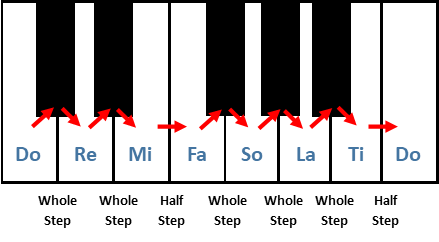
Another benefit to teaching scales using solfege is the simplicity of remembering that a major scale simply has a half-step between Mi -> Fa and Ti -> Do on the piano.
The following is an excerpt from my personal teaching book page introducing major scales:
Western Major Scales are composed of a certain sequence of steps. A major scale can start on any note at the piano. Different sequences of half steps and whole steps can create different types of scales.
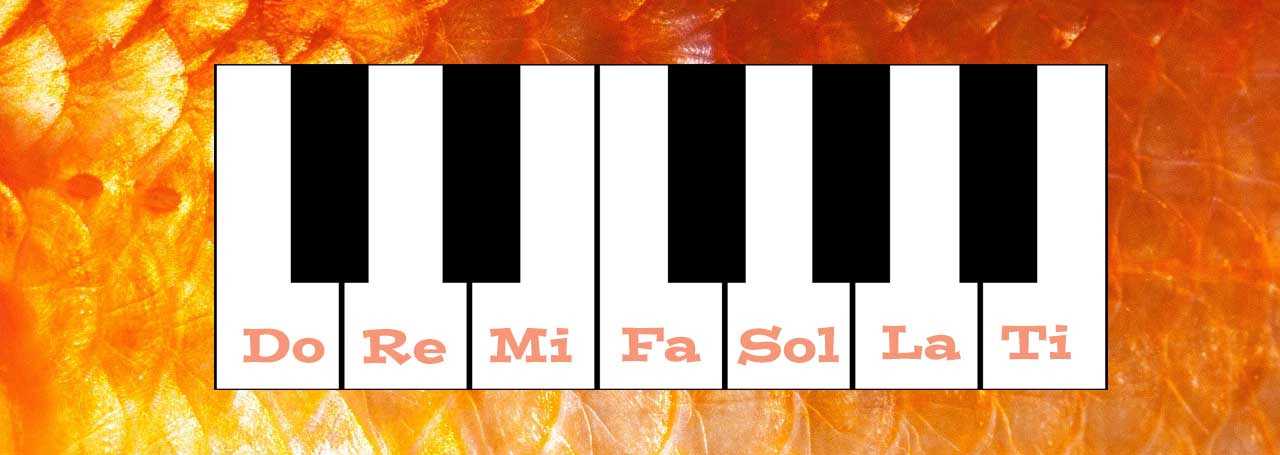
If you sing a western major scale, it matches the following set of pitches:
Do—Re– Mi– Fa– So– La– Ti– Do
This sequence of sung pitches is called solfege. Solfege was made popular in the movie, “The Sound of Music” with the song, “Do—Re– Mi” by Richard Rodgers and Oscar Hammerstein II and sung by Julie Andrews.
If you sing your major scale using solfege, all the notes will be a whole step apart except for Mi– Fa and Ti—Do, which are half steps. Plus, it will always be a major scale if the sequence of whole steps and half steps are the same no matter which note is the starting pitch.
The next step when I teach scales is how to teach the varying fingering patterns. I typically insist that my students to know their scales from memory and not read the notes. This means that my students need to know some underlying fingering concepts and then memorize the keyboard topography of the individual scales. Knowing these principles will also help my students help my students figure out fingering patterns for themselves.
Underlying fingering concepts for scales:
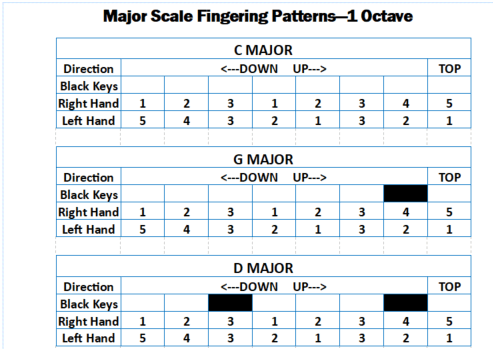
1. The first underlying fingering concept I teach is that we always try to keep the thumb on a white key whenever possible because it shifts the entire hand towards the fall board when the thumb is on a black key.
2. The second concept is that we typically use sequential groups of fingers when possible, like 1-2-3-4 and 1-2-3.
Scale keyboard topography:
Piano topography refers to the arrangement of the black and white piano keys and a pianist’s awareness of their location on the keyboard. It’s a key component of keyboard sense, which is the ability to play the piano fluently without relying on visual cues.
Definition courtesy of eNovative Piano
Several years ago I came across some images of scale fingering patterns where a dot above the finger number was used to indicate black keys. I found this scale topography image to be very compelling because that was how I typically envision scales inside my head. I then created my own version of this idea and use these scale fingering pages with my students instead of having them read the notes on a page. Here’s a sample of my current major scale fingering pattern teaching book page:
Although I haven’t created a similar page for fingering minor scales, I do like to teach minor scales using the same concepts with chromatic solfege. Chromatic solfege also really helps sing the difference between major and minor triads by simply singing the third note in the scale “Mi” and then the lower half step “Me”.
It can be handy to have scale-arpeggio reference books at times, so even though I like to teach scales without a book, I typically do make sure my students have a scale reference book. My current favorite scale reference books are: Alfred’s Basic Piano Library: The Complete Book of Scales, Chords, Arpeggios & Cadences or The Manual of Scales, Broken Chords and Arpeggios for Piano by ABRSM.
DawnTM Piano Teaching Book Pages:
DawnTM-Piano Introduction to major scales
DawnTM-Piano Major scale fingering patterns
References:
eNovativePiano. “Developing Keyboard Sense.” onlinepianocurriculum.enovativepiano.com. February 5th, 2021, https://onlinepianocurriculum.enovativepiano.com/developing-keyboard-sense/
 Piano Lessons for Adults